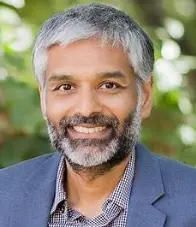
 Delivering high-quality cancer care looks different around the world; but access, coordination, and support are universal challenges. Dr. Anu Agrawal discusses how the American Cancer Society is advancing global solutions through navigation, collaboration, and the BEACON initiative.
Welcome to Cancer, Clearly, a podcast about the cancer experience told from every angle.
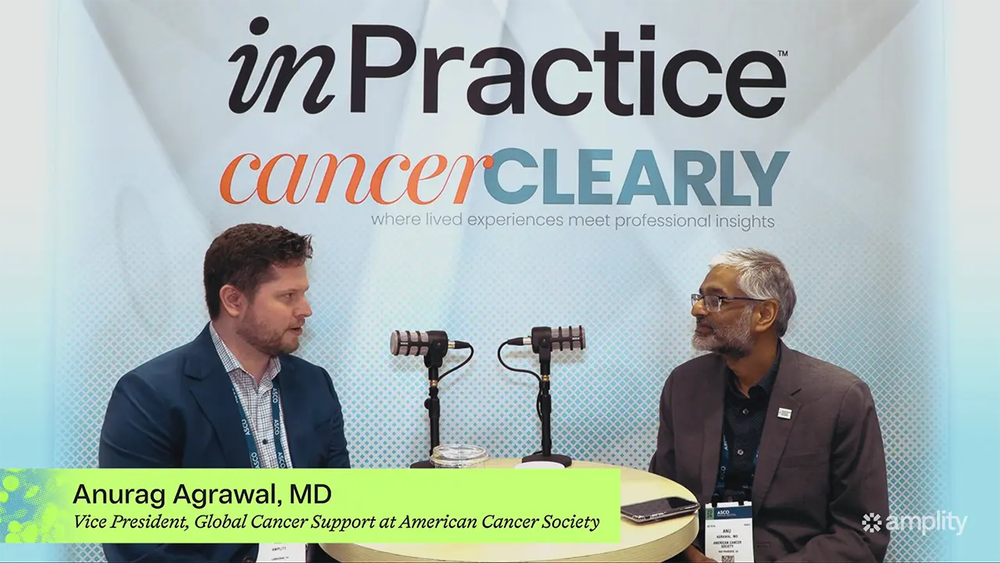
Chris: Chris Riley with Cancer, Clearly podcast, here with Dr. Anu Agrawal. How’s it going?
Dr. Agrawal: It’s going great. How about you?
Chris: I’m pretty good. We’re here at ASCO and conducting this interview today.
Dr. Agrawal: Thanks for having me.
Chris: Dr. Agrawal, you’ve had a remarkable career being a part of cancer in multiple different countries. You’re a pediatric hematologist oncologist, bone marrow transplantation physician, just overall awesome person. So, how has your experience in cancer care in diverse global settings evolved over the years?
Dr. Agrawal: Thanks for that introduction. Yeah, it’s been really a privilege and opportunity to work in so many different settings, and I think that thematically the challenges are similar across the world, and I think we can learn from each other, both learning from low-resource settings to high-resource settings and vice versa.
And so, I think today we’ll talk a lot about the patient-level challenges, which are really, for us, a key factor in thinking about how do we deliver comprehensive cancer care.
Chris: Yeah. So, you are the Vice President of Global Cancer Support at the American Cancer Society, and you’ve been to some pretty interesting places like Vietnam and Botswana. How have those experiences informed, really what you consider to be good cancer care?
Dr. Agrawal: Yeah, I’ve been very lucky to work in different settings. In Botswana, I was the medical director. I was the only pediatric oncologist in the country, and that was right after my fellowship training. There’s so much that you do in these settings that you don’t receive any training for, so I think there were many things that I took away from that experience.
Dr. Agrawal: But again, thematically, the challenges that patients and families face are the same no matter where you are in the world. In many of these settings, patients are in the hospital for their entire treatment. The parents will sleep underneath the bed or on the bed with them, and I think those are examples where I think there’s so many opportunities to make small changes that can make an incredible difference so that they can potentially go back and forth from home rather than being in the hospital for the entire treatment regimen.
Chris: I have a soft spot for peds too, and used to work in peds onc drug development. So, what are some of the biggest challenges that these families are facing, really even globally when it comes to pediatric cancer care?
Dr. Agrawal: Yeah, I think, again, it’s the same for both pediatric patients, for their families, as well as adults with cancer. Number one is the financial toxicity, and this is across the world, that we don’t necessarily think about, but by far and away it’s the financial toxicity of having to go through treatment, the costs associated with treatment, and then all the implied costs with having to travel, not being able to work.
And in low-income settings, it’s incredibly challenging because typically there are no public health insurance systems. There are in some countries, but in most countries, families are having to pay out of pocket. And then imagine systems where drugs are not readily available. You may be buying them on the black market, not knowing whether they’re actually the real medication or not, and outcomes are poor, and so you’re often paying for a treatment that’s not going to be successful, wiping out your life savings.
So, that financial toxicity is a reality that we faced, and from my standpoint, we shouldn’t put patients and families through that unless we know that they’re going to be able to get through treatment, be able to afford it, and be able to get back to their life.
Chris: Yeah. It’s so hard and so disruptive. Can you tell us a little bit more about what ACS is doing for the broader group of cancer patients?
Chris: I think it’s great that we’re focusing on and including peds, but we can’t forget about the larger group.
Dr. Agrawal: Patient-centered care is incredibly important. I think there’s more and more talk about patient-centered care, comprehensive care, holistic care, but I think the next step really is what are we doing to achieve that?
I think that if we look at national cancer control plans globally, those terms are getting included more, so that’s a good first step, an awareness step. But next, we need to think about what are the actionable evidence-based solutions that we can implement in diverse settings to be able to actually make real change.
Dr. Agrawal: And for us at the American Cancer Society, we’ve had a very long history in using patient navigation as a tool, as an evidence-based tool to be able to improve outcomes for patients and families, and thinking about the individualized barriers that we can assess and provide support for.
And again, this is across settings. There is really no difference if you look at low-income settings and high-income settings, the challenges that families face as far as financial toxicity, lack of transportation, lack of accommodations, those are across all setting types, and patient navigation is a tool. If you had an ideal healthcare system where patients were not reduced just to their medical diagnosis. This is an 18-year-old with leukemia, but rather thinking about this is a person that has this diagnosis and has all of these associated needs, how are we thinking about them holistically, you wouldn’t need patient navigation. But we’re not there yet. Hopefully we’ll be one day where we don’t need patient navigation, but in the current system where really the focus is on just the diagnosis and the treatment, that we need to have additional supports to be able to support the patient and the family.
Chris: Absolutely. And the rise of the navigator, and for some of you who are listening who don’t know, this is one of the most important roles, that you may have never heard about. We have clinical navigators, we have patient navigators that are there to really help and support these patients on their cancer journey, and really involving the navigator is a crucial piece to what you’re doing at ACS.
Chris: Can you tell me a little bit more about how involving the navigator and how this concept transformed into the Global Alliance for Patient Navigation?
Dr. Agrawal: Sure, yeah. I think for us, a lot of this work started in the United States, working with marginalized, vulnerable populations whose outcomes continue to remain worse, and there’s multiple different population groups for which that still remains the case.
And thinking about what are the additional supports, especially at a community level, having somebody who’s had the same experience as you, speaks the same language as you, can really talk to you in a much more horizontal way rather than the hierarchical vertical system that we all experience in the medical field, that makes a huge difference. You need to have a trusted advisor who you can speak with and who you can really talk to about your fears, and that person can then advocate for you.
So, in the United States, a lot of that work has happened over the last 3 to 4 decades, developing legislation so that there is a navigator role that’s compensated. But we still have a lot to do in terms of role definition. A patient navigator is a new role outside of the current healthcare roles, and that we still need to make a lot of progress in having more of those positions available within the health system, and recognizing that role is different than the role that’s played by a nurse oncologist, clinical nurse specialist, that they may provide some navigator services. But often we find that it’s very disease-specific and very focused on, again, the diagnosis and the treatment, and not focused on all of these other needs that the patient and family have. So I think we still have a long way to go to really start to develop patient navigation-patient navigators as something that’s available within all health systems, not only for cancer patients but definitely for all patients with chronic conditions, and also within the community setting. And that’s the same work that we’re now doing globally. And the Global Alliance for Cancer Patient Navigation came out of that desire, similar to the National Navigation Roundtable, to start to develop standards.
What are the core functions that you are providing to say you have a navigator program? So, we need to define that very clearly. It could be a small number, and we can be aspirational into the 50 or 60 domains that are present right now in the literature. But at least starting with something small, developing the core principles around training, developing the core terminology, and then thinking about what are the frameworks for implementation that are sustainable, what are the frameworks for policy and advocacy so that we can start to develop awareness as a first step, but also then sustainable programs that can be developed in diverse settings over time.
Chris: And the feedback from implementing these patient navigator programs has been phenomenal. Patients love interacting with the navigators, whether it’s clinical- or advocacy-focused. And so, it’s just really incredible work that you all are doing over at ACS.
Dr. Agrawal: The evidence base in the United States especially is growing as far as the benefits for patients and families in having navigator services. We’re lacking that evidence, although it’s growing in diverse low/middle-income settings globally. And then the second piece really is showing that cost efficacy is still lacking across settings, including the United States. That’s also one of the goals for us as part of the alliance: How do we start to identify those groups that can start to develop more evidence around that cost efficacy?
Because, for policymakers, that’s going to be a really clear step. We’re pretty certain that’s the case, but we need the evidence to really bring this forward to show that it’s not only a benefit, improves quality of life, but it also has cost efficacy.
Chris: Right. And so, generating that data is a huge part of even having the alliance and sharing what has worked, what might work-all these different models.
How has that informed what you’re doing in the Global Alliance? And I know that the Global Alliance is also part of a larger initiative called BEACON. Can you describe what that initiative is and what some of the milestones and goals are?
Dr. Agrawal: Similar to the work in the United States, we’ve really built foundationally from one program to the next. So, BEACON was the first program that we developed globally for patient navigation. BEACON stands for Building Expertise, Advocacy, and Capacity for Oncology Navigation. It’s a very extensive self-service toolkit for organizations, ministries of health to be able to develop a navigation program that’s adapted to their local context with local stakeholders, ideally in a sustainable fashion.
BEACON has grown significantly as we’ve opened it up now to organizations. We have about 30 countries and 60 organizations that are part of BEACON. One of the most valuable parts of BEACON has been the community of practice, where organizations can come together and talk about how they develop their program, how they overcome barriers, what’s the model that works for them.
Again, recognizing there’s no one model. You have to develop the model that works in your setting. So that was really where we started, and we’re continuing to grow BEACON. BEACON’s open to organizations that want to build a sustainable practice that’s adapted to their local context.
Dr. Agrawal: Building upon BEACON, we then started a program called SPARK in 2025, Supporting Patient Navigation, Adoption, Replication, and Knowledge Exchange. So, this is in 3 countries. It’s in Indonesia, Kenya, and Nigeria. And the focus of this program is to work with local stakeholders to develop navigation frameworks within that country that are sustainable and implementable with local stakeholders really leading that effort. And the goal is to develop not only policy frameworks but also models for implementation that can be used across the country.
Ideally, developing a connected network where you have navigation that’s provided to patients not only in treatment facilities, but also to be able to access services if you screen positive. It’s a huge goal, right? And it’s going to take a lot of time, but it starts to develop the internal framework where the countries are in charge of building these programs, and we’re very hopeful that will create models that we can then use for other countries to be able to implement similar programs.
So those complement very well what we’re trying to do with the Global Alliance, which brings together stakeholders globally in diverse settings, really thinking about, number one, building awareness. Still, I think in many settings, people don’t know or feel like there’s not a need for a navigator. We hear in some high-income settings, “We’ve addressed that.”
Chris: Right.
Dr. Agrawal: “Patients are getting what they need.” But in reality, if you follow the patient on their journey from their house to treatment, there’s so many gaps in every setting, so that need is there, so building awareness is still a first and foremost need for navigation. Second is then, as we talked about, starting to develop some of these frameworks for a sustainable implementation, and then consensus-building is really key.
We have to ensure that we’re using similar terminology that’s also adaptable to the cultural context, and that we’re starting to talk about it in the same way, and that will also help us with developing evidence generation that’s easily translatable across the world.
Chris: I can imagine that in those meetings, one of the most fun things about it is that aha moment when they get it. Like, you’ve got all the data, and you’re like, “This is what a patient navigator does,” and they’re like, “Oh, this makes so much sense. Why haven’t we been doing this before?”
Dr. Agrawal: For certain, yeah. I think building that awareness, the organizations that we work with are incredibly passionate because they’ve seen the pre and the post. They’ve seen what things were like before they had navigators, and they’re seeing how things are for patients after the development of a navigation program.
Dr. Agrawal: So there is so much passion about helping to build that awareness, and we’ve also been able to, similar to BEACON, develop a community of practice, which we’re trying to grow now through the alliance because that’s also been something we realized after this first year, having that group to come together and share the experience and what were the barriers, how did we overcome them, and then I think how do we grow it together. I think that’s still a big goal for all of us.
Chris: It’s not just patient satisfaction scores, you know? It’s really that deeper connection. So really getting down to the core challenge or trying to distill the core challenge succinctly. How do we help oncology teams, healthcare systems, policymakers understand that patient navigation isn’t just a nice-to-have but is actually a critical part of qualitative cancer care?
Dr. Agrawal: As you said, how do we create that aha moment? And at the end of the day, I think it’s like when we go through implicit bias training to say, “I have implicit bias.” You can’t tell somebody they have implicit bias. They have to have that aha moment when they realize. And I think it’s the same with navigation.
If you look at the data, for instance, if you ask the clinician, “Did I talk to this patient about supportive care?” 80% of them will say yes. But if you ask the patient, 20% of them or less will say, “You talked to me about supportive care.” So, there’s this incredible gap between what the clinician team thinks they explained and what the patient understood, and that’s just one example that is in some ways, navigation is a larger bucket of that, is to say, “Yes, we did talk about the social determinants of health and address them,” but in reality, that’s just not the case, right? So, I think health systems are starting to have this aha moment of we are not providing holistic care, we’re not providing equitable care, and that patient navigation is an evidence-based solution.
Chris: Right. And having them check in on the patient as they’re going through their own journey, they’re receiving a deluge of data, so even if you are going through that checklist of, “Yes, we actually did cover that,” they may not have processed it at that time. So having a navigator come back in and making sure that the patient understands what’s going on, what their issues and challenges are, is super important.
Dr. Agrawal: And needs change over time. I think also that if you look at doing a needs assessment once when the patient first arrives, that has to be done at multiple time points throughout the care journey, and it’s going to change just with time. It’s going to change if the patient has a recurrence. It’s going to change if the patient goes into survivorship.
It’s going to change due to life events, and so those need to be continually, again, asked those questions, “What are your barriers?” And people are not going to necessarily. The first time they meet the medical team, they’re going to be intimidated. They’re not going to say, “I need help with transportation,” right?
That’s a discussion that will come with someone that they trust. Someone that they can speak to more freely and often that’s somebody who’s outside of the medical system.
Chris: And some of these stories are just, they make your heart swell. Some of the navigators become friends, with the patients.
All right, Dr. Agrawal, I know that you guys have the LION program, the CARES program, a lot of really cool acronyms over at ACS. Can you tell us a little bit about that?
Dr. Agrawal: Sure, definitely. A lot of the work that we’re doing globally in navigation has been informed by the work that we’ve done domestically, and so two of our programs. One is called CARES−Community Access to Resources, Education, and Support. It’s an app that patients can access or their caregivers can access to be able to learn more about their diagnosis, their treatment regimen, wellness activities, as well as connect to resources, which can also be done through our call center.
And second, LION is Leadership in Oncology Navigation. It’s a training program that’s now free for patient navigators, and these are programs, especially LION, that we’re hoping with the alliance to be able to potentially bring to settings outside the United States as well.
Chris: So, Dr. Agrawal, one thing that really stood out is the concept that you have developed in the Global Alliance within BEACON, and that’s sharing these resources, learnings, and models, and go back to that, and how they could work in a variety of different systems, infrastructures around the world, and overall sizes of different countries and populations.
So, if somebody is in a developing country now and they’re listening in, how could they get access to these models or even share their own models that they found work for patient navigation, for the Global Alliance?
Dr. Agrawal: So, we’re focused 100% on collaboration. BEACON is a tool. There are multiple other tools out there, and BEACON may not be the best tool for every organization, and we would never want that.
So, one of the first goals of the alliance is to develop a resource repository that would be available so that organizations could then choose those tools that were most useful for them for both patient navigation program development, for training of navigators, for developing advocacy around health policy.
So, that’s something that we’re working on right now. Joining the alliance is open, so we’re very happy to have organizations that are starting to do navigation join the alliance to help us develop our ongoing work. And then BEACON is also open to organizations that are wanting to build navigation programs.
And again, there’s other programs also are available. So happy to share that information and to connect any organizations that are interested in joining BEACON or the alliance or other programs.
Chris: Yeah. And just to clarify, anybody can join, even if they’re not in a developing health system, correct?
Dr. Agrawal: Correct. For the alliance, we’re focused on diverse settings outside of the US. We have the National Navigation Roundtable, which we work closely with and align with here in the United States, and the alliance is really focused on all settings because, again, the needs are the same, whether you’re in a high-income country or a low/middle-income country.
At the end of the day, there are patient needs across all of these settings, and we see navigation as a tool across all of these settings. So, the alliance has members from all 6 continents. We have over 30 countries and over 60 organizations that are participating.
Chris: That’s awesome.
Chris: Got a bonus question for you. So, what’s the one ASCO buzzword you’re hearing everywhere this year?
Dr. Agrawal: So, I’m a pediatric oncologist, and I think I can find a way to link this to navigation. But for me, it’s been KRAS. KRAS is a significant mutation in many cancers and many pediatric cancers too, and was really thought to be undruggable, and being able to now have drugs that can potentially target KRAS is an incredible breakthrough.
And I think it just speaks to the rapid pace of innovation that’s happening, and we have to always remember that we cannot leave patients behind as we innovate. And I think that is always a challenge, and we have to always keep the patient voice, the patient experience, the person with lived experience as part of that discussion, that the innovation that’s happening within the drug development space can also happen within spaces that’s going to actually benefit the patient experience.
Chris: No matter how small the patient population. Awesome. Well, that’s it for today. Thank you for joining us.
Dr. Agrawal: It was my pleasure. It was great talking with you. Thanks so much.
Outro: If this conversation resonated with you, be sure to subscribe and share it with a colleague, a family member, or a friend. Thank you for showing up, for listening with care, and for being a part of this community.
This has been Cancer, Clearly.