Abstract
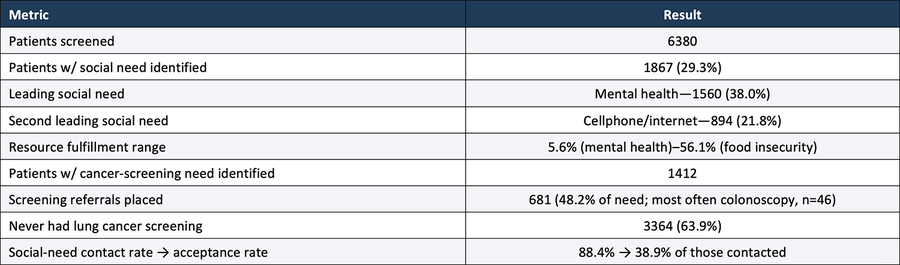
Social determinants of health (SDoH) drive a substantial share of cancer disparities, yet few independent oncology practices publish operational data on closing these gaps. Carolina Blood and Cancer Care Associates, a physician-owned practice in rural South Carolina, partnered with the nonprofit No One Left Alone (NOLA) to screen patients for SDoH/health-related social needs and connect them to resources and cancer-screening referrals. As of 8/7/2026, 6380 patients were screened; 1867 had an identified social need and 1412 had a cancer-screening need. Mental health (38.0%) and cellphone/internet access (21.8%) were the leading social needs. Cancer-screening referrals were completed for 681 patients (48.2% of those with a need). Resource fulfillment ranged from 56.1% (food insecurity) to 5.6% (mental health), exposing a marked behavioral-health gap. This practice-based model—screening tool, staffing, Z-code documentation, and workflow—is reproducible for independent oncology practices building SDoH programs.
Background
Social determinants of health (SDoH)—the nonmedical conditions in which people live and work—account for a larger share of health outcomes than clinical care itself, and cumulative SDoH burden is independently associated with higher cancer mortality.1,2 Despite this evidence, independent community oncology practices, which deliver most US cancer care, have published little operational data on how to build and sustain SDoH screening programs. This brief updates practice-level outcomes from the NOLA initiative at Carolina Blood and Cancer Care Associates (CBCCA), previously presented at the 2025 NCODA Cancer Care Impact Summit,3 with cumulative results through August 7, 2026.
The NOLA Program
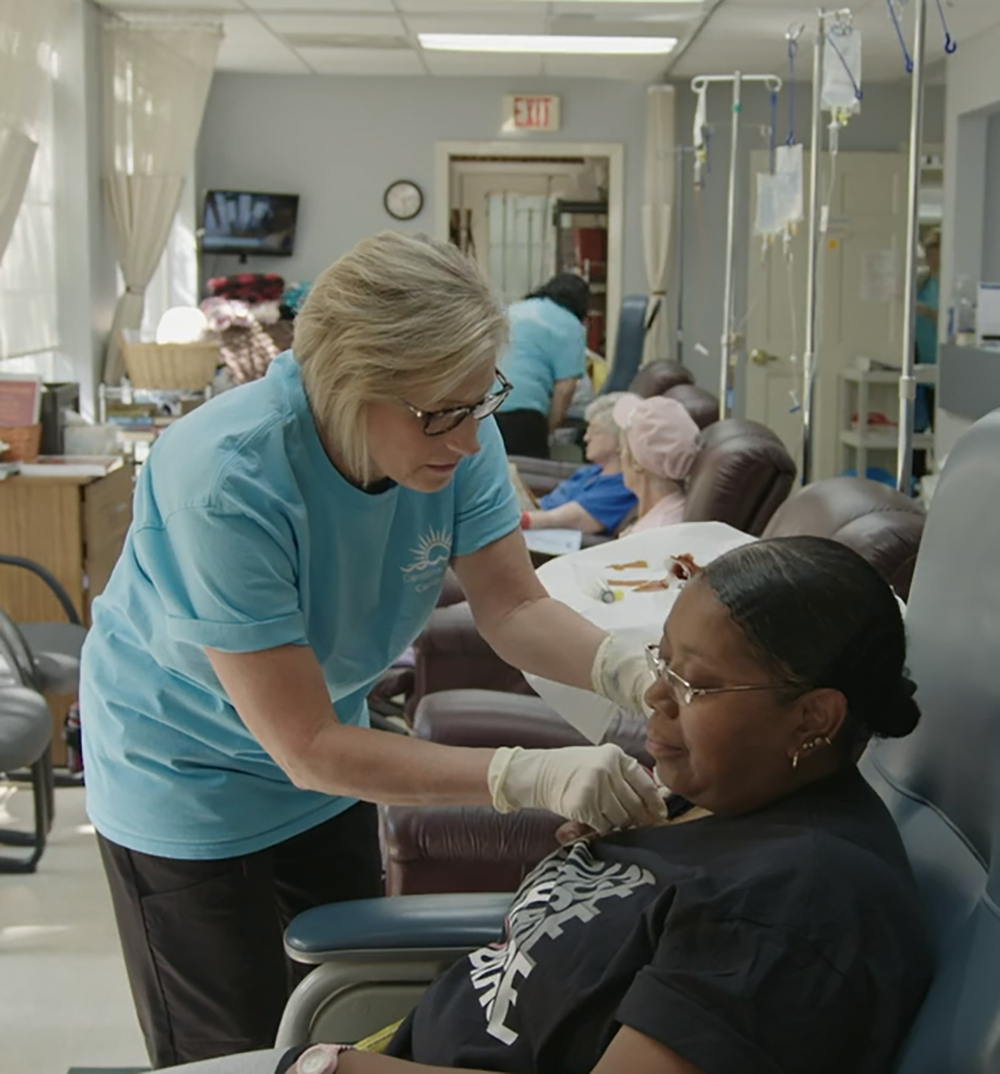
CBCCA, based in Rock Hill, SC, serves a largely rural 5-county region. Since 2022, CBCCA has partnered with No One Left Alone (NOLA), a 501(c)(3), to screen every patient using a structured intake form covering income, food security, housing, transportation, mental health, cellphone/internet access, health literacy, and cancer-screening history. Identified needs are coded with ICD-10 Z-codes (Z55–Z65) and tracked to resolution through weekly interdisciplinary huddles, supported by a curated local resource directory. The program runs on approximately 0.75 full-time equivalent (FTE) of dedicated navigation staff per physician.
Results (cumulative, as of 8/7/2026)
Figure 1. No One Left Alone (NOLA) Intake Volume and Identified Need Categories
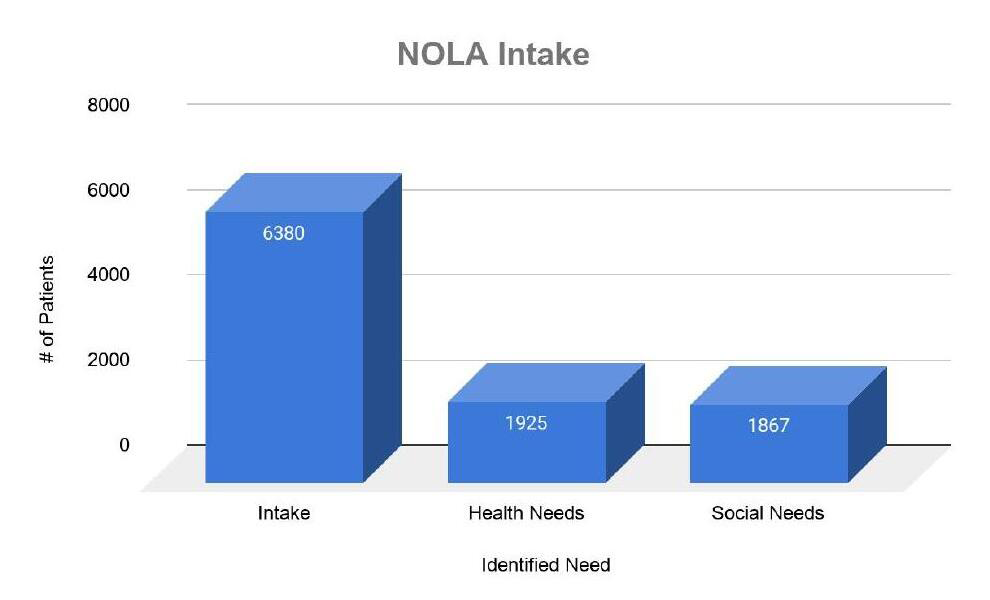
Table 1. Key Program Outcomes
The screened population was 64.3% White patients and 30.3% Black patients, with lower proportions of Hispanic, Asian, and Native American patients. Over 60% of patients reported a household income below $50,000. Food insecurity showed a clear racial gap: 8.1% among Black patients vs 5.2% among White patients,4 while self-reported health literacy exceeded 90% across all groups—indicating that access barriers are more financial/structural than literacy related.
Discussion and Practice Implications
Since an earlier internal snapshot of ≈ 3210 patients screened, (No One Left Alone (NOLA) / CBCCA. SDoH Playbook #2 (internal program document), program volume has roughly doubled without a proportional increase in staffing, suggesting the model scales efficiently. The starkest finding is the mismatch between mental-health need (the largest category) and fulfillment (the lowest of any category)—reflecting the well-documented rural behavioral-health shortage rather than a workflow failure, and marking the clearest target for future investment (telehealth behavioral-health partnerships, expanded referral agreements). By contrast, food-insecurity and healthcare-access needs were fulfilled at >50%, reflecting mature local food-bank/FQHC partnerships that could serve as a template. The 88.4%-to-38.9% contact-to-acceptance drop-off suggests contact rate alone is an incomplete SDoH quality metric.
- Staffing model: ~0.75 FTE navigation/social-work support per physician was sufficient at this volume
- Z-codes (Z55–Z65) support both documentation and chronic care management–based reimbursement pathways
- Behavioral-health referral capacity is the single highest-leverage gap to close next
- Stratify outcomes by race/income—aggregate reporting alone masks disparities such as the food-insecurity gap between Black and White patients
Conclusion
Structured SDoH/health-related social needs screening with a local-resource referral workflow is feasible and scalable within an independent community oncology practice, meaningfully increasing cancer-screening referral completion while revealing a persistent, actionable behavioral-health resource gap in rural care delivery.
References
- Centers for Disease Control and Prevention. Social determinants of health. Updated March 29, 2022. Accessed September 3, 2026. https://www.cdc.gov/about/priorities/social-determinants-of-health-at-cdc.html
- Pinheiro LC, Reshetnyak E, Akinyemiju T, Phillips E, Safford MM. Social determinants of health and cancer mortality in the REGARDS cohort study. Cancer. 2022;128:122-130.
- Patel K, Gor A, Naidu S, et al. The role of SDoH and HrSN data in addressing cancer health disparities through Project No One Left Alone. Poster presented at: NCODA Cancer Care Impact Summit; 2025.
- USDA Economic Research Service. Food security in the U.S.: key statistics and graphics. Accessed September 3, 2026. ers.usda.gov
Abstract
Social determinants of health (SDoH) drive a substantial share of cancer disparities, yet few independent oncology practices publish operational data on closing these gaps. Carolina Blood and Cancer Care Associates, a physician-owned practice in rural South Carolina, partnered with the nonprofit No One Left Alone (NOLA) to screen patients for SDoH/health-related social needs and connect them to resources and cancer-screening referrals. As of 8/7/2026, 6380 patients were screened; 1867 had an identified social need and 1412 had a cancer-screening need. Mental health (38.0%) and cellphone/internet access (21.8%) were the leading social needs. Cancer-screening referrals were completed for 681 patients (48.2% of those with a need). Resource fulfillment ranged from 56.1% (food insecurity) to 5.6% (mental health), exposing a marked behavioral-health gap. This practice-based model—screening tool, staffing, Z-code documentation, and workflow—is reproducible for independent oncology practices building SDoH programs.
Background
Social determinants of health (SDoH)—the nonmedical conditions in which people live and work—account for a larger share of health outcomes than clinical care itself, and cumulative SDoH burden is independently associated with higher cancer mortality.1,2 Despite this evidence, independent community oncology practices, which deliver most US cancer care, have published little operational data on how to build and sustain SDoH screening programs. This brief updates practice-level outcomes from the NOLA initiative at Carolina Blood and Cancer Care Associates (CBCCA), previously presented at the 2025 NCODA Cancer Care Impact Summit,3 with cumulative results through August 7, 2026.
The NOLA Program
CBCCA, based in Rock Hill, SC, serves a largely rural 5-county region. Since 2022, CBCCA has partnered with No One Left Alone (NOLA), a 501(c)(3), to screen every patient using a structured intake form covering income, food security, housing, transportation, mental health, cellphone/internet access, health literacy, and cancer-screening history. Identified needs are coded with ICD-10 Z-codes (Z55–Z65) and tracked to resolution through weekly interdisciplinary huddles, supported by a curated local resource directory. The program runs on approximately 0.75 full-time equivalent (FTE) of dedicated navigation staff per physician.
Results (cumulative, as of 8/7/2026)
Figure 1. No One Left Alone (NOLA) Intake Volume and Identified Need Categories
Table 1. Key Program Outcomes
The screened population was 64.3% White patients and 30.3% Black patients, with lower proportions of Hispanic, Asian, and Native American patients. Over 60% of patients reported a household income below $50,000. Food insecurity showed a clear racial gap: 8.1% among Black patients vs 5.2% among White patients,4 while self-reported health literacy exceeded 90% across all groups—indicating that access barriers are more financial/structural than literacy related.
Discussion and Practice Implications
Since an earlier internal snapshot of ≈ 3210 patients screened, (No One Left Alone (NOLA) / CBCCA. SDoH Playbook #2 (internal program document), program volume has roughly doubled without a proportional increase in staffing, suggesting the model scales efficiently. The starkest finding is the mismatch between mental-health need (the largest category) and fulfillment (the lowest of any category)—reflecting the well-documented rural behavioral-health shortage rather than a workflow failure, and marking the clearest target for future investment (telehealth behavioral-health partnerships, expanded referral agreements). By contrast, food-insecurity and healthcare-access needs were fulfilled at >50%, reflecting mature local food-bank/FQHC partnerships that could serve as a template. The 88.4%-to-38.9% contact-to-acceptance drop-off suggests contact rate alone is an incomplete SDoH quality metric.
- Staffing model: ~0.75 FTE navigation/social-work support per physician was sufficient at this volume
- Z-codes (Z55–Z65) support both documentation and chronic care management–based reimbursement pathways
- Behavioral-health referral capacity is the single highest-leverage gap to close next
- Stratify outcomes by race/income—aggregate reporting alone masks disparities such as the food-insecurity gap between Black and White patients
Conclusion
Structured SDoH/health-related social needs screening with a local-resource referral workflow is feasible and scalable within an independent community oncology practice, meaningfully increasing cancer-screening referral completion while revealing a persistent, actionable behavioral-health resource gap in rural care delivery.
References
- Centers for Disease Control and Prevention. Social determinants of health. Updated March 29, 2022. Accessed September 3, 2026. https://www.cdc.gov/about/priorities/social-determinants-of-health-at-cdc.html
- Pinheiro LC, Reshetnyak E, Akinyemiju T, Phillips E, Safford MM. Social determinants of health and cancer mortality in the REGARDS cohort study. Cancer. 2022;128:122-130.
- Patel K, Gor A, Naidu S, et al. The role of SDoH and HrSN data in addressing cancer health disparities through Project No One Left Alone. Poster presented at: NCODA Cancer Care Impact Summit; 2025.
- USDA Economic Research Service. Food security in the U.S.: key statistics and graphics. Accessed September 3, 2026. ers.usda.gov